Field guideJuly 20, 2026The Vaaya team
The State of Agentic Payments
A field guide to how software learned to spend — who's building the rails, what's actually live, and the problems nobody's solved yet.
The dated comparison table for these rails and protocols, kept current, is in AI agent payment protocols compared: x402, MPP, ACP, AP2, UCP. This piece is the longer argument.
TL;DR — the agent can finally think and act. The last thing standing between it and the economy was permission to pay. In the last twelve months, everyone from Coinbase to Visa to OpenAI shipped a version of that permission. Almost none of it agrees with the rest.
Why this is suddenly the whole game
For two years the hard part of agents was cognition — can it plan, can it use a tool, can it not hallucinate the answer. That's mostly solved enough to ship. The moment an agent can act, though, the interesting actions cost money: buy the API call, book the flight, top up the compute, pay the other agent for the sub-task.
And the existing payment stack was built on an assumption that just broke: that a human is in the loop at the moment of payment. A card number is a bearer credential guarded by a person tapping "confirm." A checkout page is a human-shaped funnel. Hand that to software and every layer — authentication, authorization, fraud, disputes, KYC — has to be re-answered from scratch, because the buyer is now a program acting on someone's behalf.
That re-answering is the entire field of "agentic payments." Here's the map.
The four camps
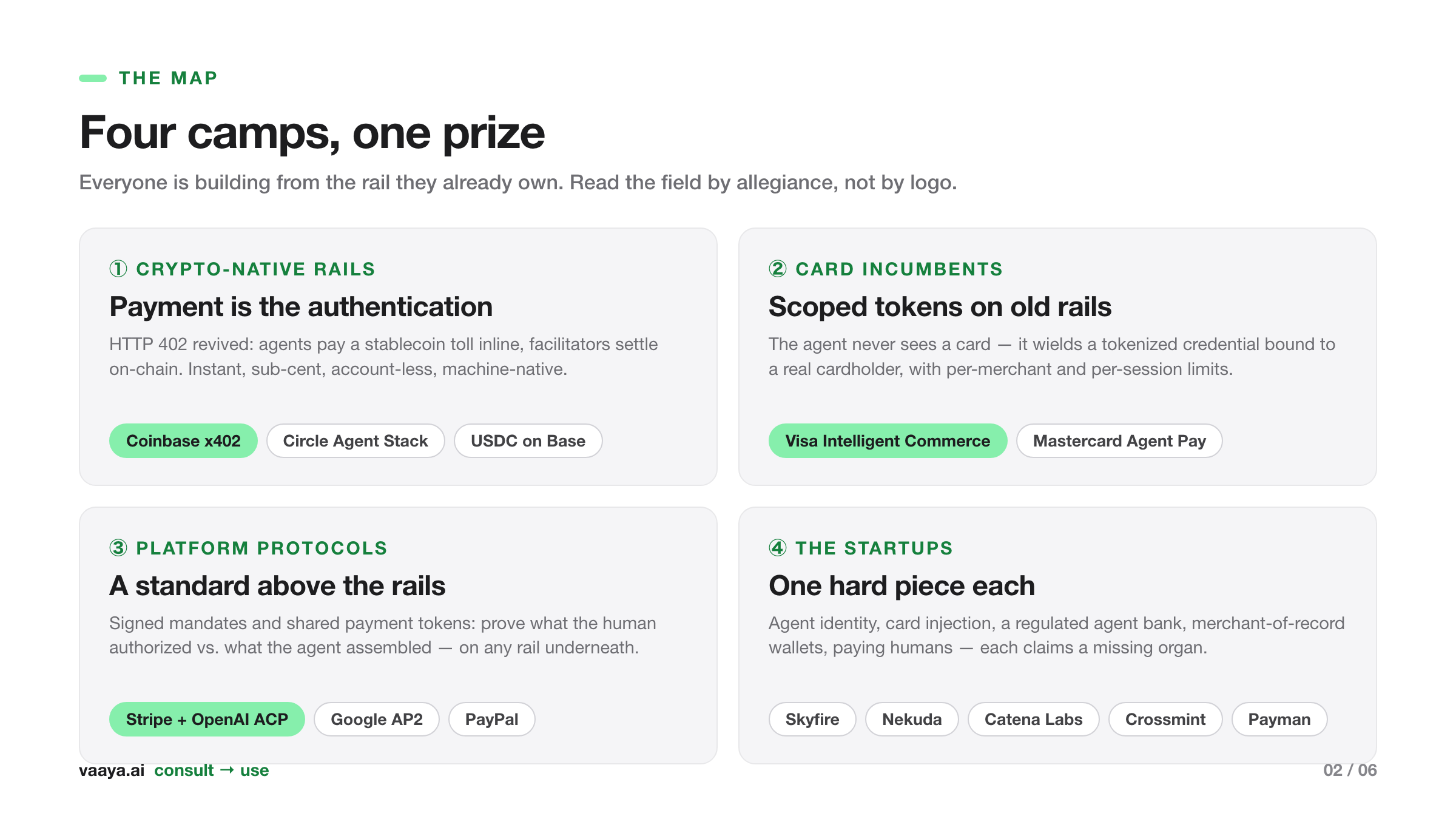
Everyone building this is coming at it from where they already stand. That's the fastest way to read the landscape — not by company, but by which rail they're defending.
① The crypto-native rails. Coinbase's x402 revives the dormant HTTP 402 Payment Required status code: an API returns 402, the agent pays a stablecoin toll inline over HTTP, a facilitator settles it on-chain, the resource comes back. Payment is the authentication. Circle sits underneath as the USDC issuer, and shipped its own Agent Stack (agent wallets, a marketplace, gas-free "Nanopayments" down to $0.000001). The pitch: instant, global, sub-cent, account-less, machine-native money.
② The card incumbents. Visa Intelligent Commerce and Mastercard Agent Pay are doing the opposite — keeping the card rail and issuing the agent a scoped, tokenized credential bound to a real cardholder, with per-merchant and per-session limits. The agent never sees a card number; it wields a token that draws on the human's existing line. The pitch: you already trust cards, and they come with fraud and dispute machinery built over sixty years.
③ The platform protocols. Stripe + OpenAI co-authored the Agentic Commerce Protocol (ACP), whose core trick is a Shared Payment Token — ChatGPT can initiate a purchase scoped to one merchant and one cart total without ever touching your card. Google's AP2 takes the credential idea further: every purchase is three signed Mandates — Intent, Cart, Payment — so a merchant can cryptographically verify what you authorized versus what the agent assembled. PayPal shipped an agent toolkit and MCP server. The pitch: a neutral standard above any single rail.
④ The startups. A wave of them, each claiming one hard piece: Skyfire ("Know Your Agent" identity + a payments network), Nekuda (tokenized card credentials injected at checkout), Catena Labs (a regulated AI-native bank for agents, from a Circle co-founder), Crossmint (agent wallets + virtual cards as merchant-of-record), Payman (agents paying humans, human-in-the-loop).
Live vs. slideware
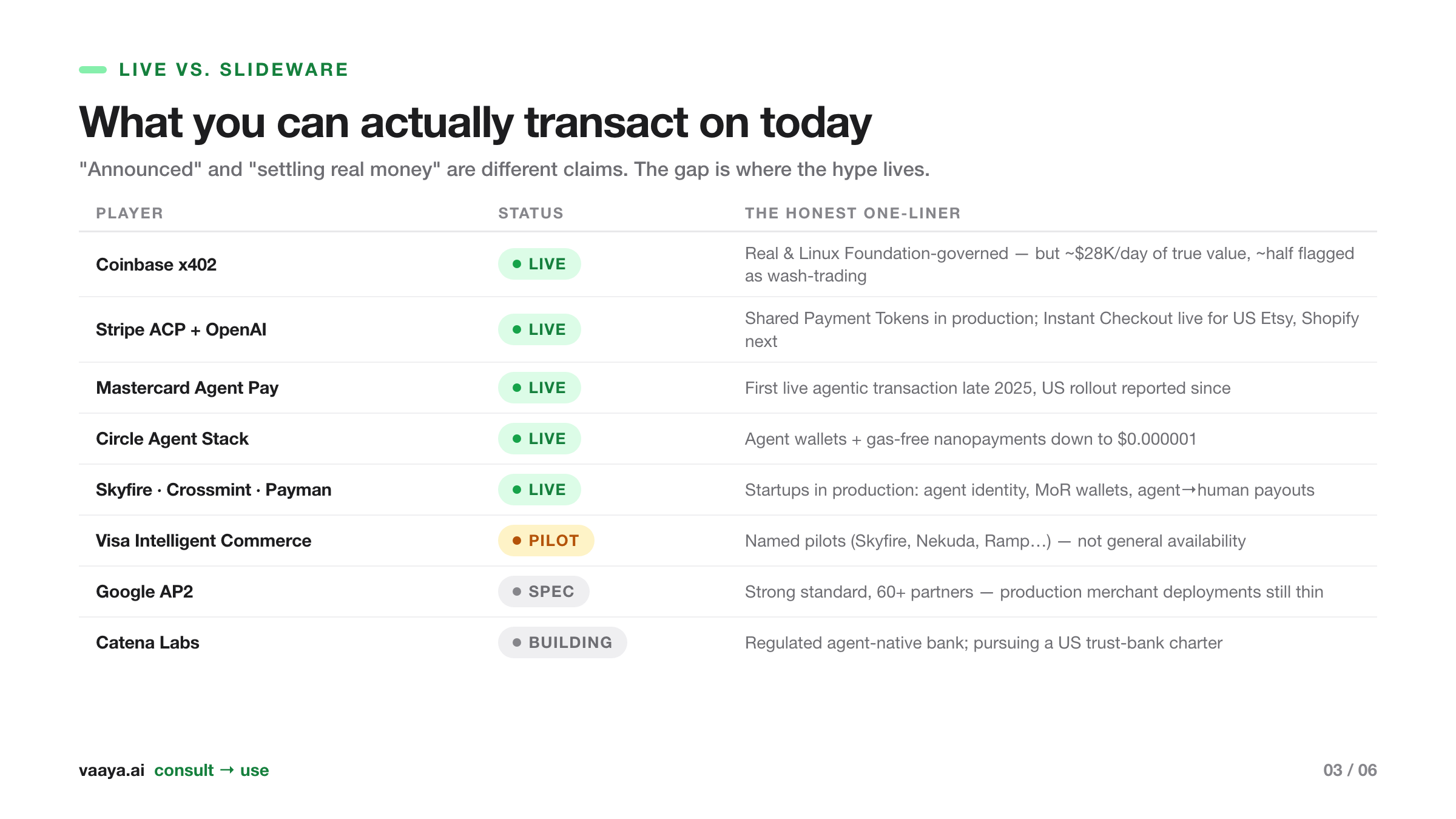
Here's the part the press releases blur. "Announced" and "you can transact on it today" are very different claims, and the gap is where most of the hype lives.
Actually live:
- x402 — real, in production, governance handed to the Linux Foundation (April 2026) with Visa, Stripe, Circle, Google, Cloudflare, AWS all signed on as members. But be honest about the volume: 100M+ cumulative transactions on Base sounds enormous until you learn it's roughly $28K/day of real value at a ~$0.20 average, and third-party analysts (Artemis) flagged about half of it as wash-trading or self-dealing — their wash-adjusted 30-day figure came to ~$1.6M. The plumbing is real. The economy running through it is a rounding error — for now.
- Mastercard Agent Pay — reached full US-cardholder availability in November 2025 (after a September 2025 Citi/US Bank pilot); by June 2026 Mastercard had extended it with "Agent Pay for Machines" for agent-to-agent payments.
- OpenAI Instant Checkout — launched February 2026 for US Etsy sellers with a million-plus Shopify merchants "coming soon" — but OpenAI has since pulled back. By mid-2026 fewer than ~30 Shopify merchants had ever gone live with true in-chat completion, and OpenAI is pivoting to retailer "apps" where the buyer finishes on the merchant's own storefront. A textbook case of the announce-to-live gap this guide is about.
- Stripe ACP and Circle Agent Stack — both shipped and documented.
- Among startups: Skyfire, Crossmint, Payman are in production; Nekuda's SDK is out.
Announced or in pilot:
- Visa Intelligent Commerce — live pilots (Skyfire, Nekuda, Ramp, others), not general availability.
- Google AP2 — a strong spec with 60+ partners, but production merchant deployments are still thin. It's a standard racing to become a habit.
- Catena Labs — building; pursuing a national trust-bank charter. Nekuda — early.
The five problems nobody has actually solved
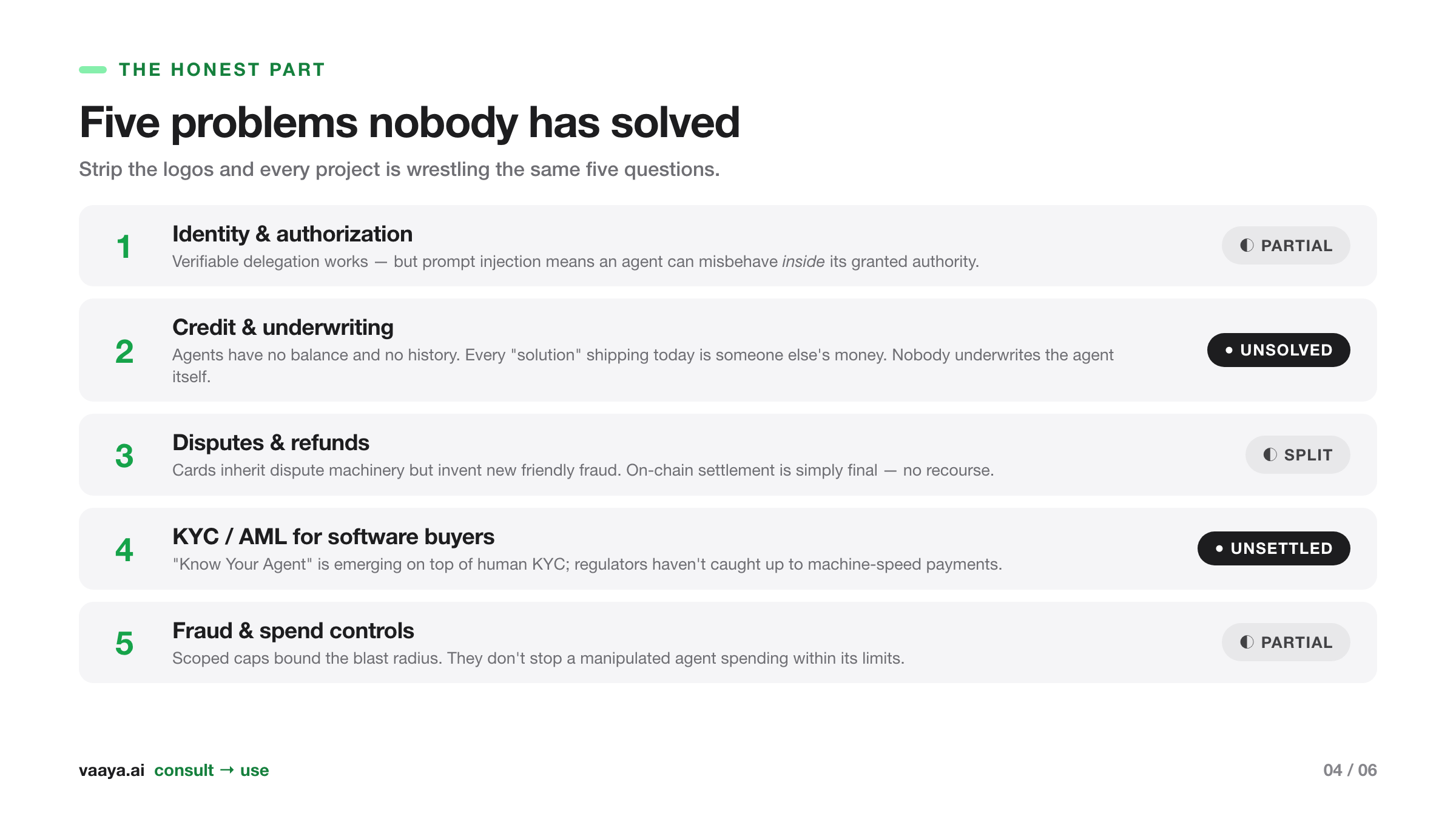
Strip away the logos and every one of these projects is wrestling the same five questions. None is fully answered.
1. Identity & authorization — the confused deputy. How does a merchant know this agent truly acts for a real person, within real limits? The whole field converged on the same answer — verifiable delegation: a signed mandate or token (AP2's Mandates, the card networks' agent-bound tokens, Skyfire's "Know Your Agent" credentials) proving scope. It's a genuinely good answer to authorization. It does nothing for the deeper hole: prompt injection is unsolved, so an agent manipulated into spending within its granted authority is still doing something you never intended. And there's no single identity standard — three incompatible ones are competing right now.
2. Credit & underwriting — who fronts the money. This is the quiet one, and it's the least solved. An agent has no balance and no credit history. Every "solution" shipping today is really someone else's money: a prefunded stablecoin wallet, or a card token drawing on the human's existing line. Nobody has extended credit to an agent itself. It's the principal's capital, start to finish. The first team that safely underwrites an agent — not its owner — unlocks a different category of autonomy.
3. Disputes, chargebacks, refunds. The card camp inherits sixty years of dispute machinery — a real edge — but invents a new fraud class: "I didn't authorize that," when the agent technically did, exactly as instructed. The crypto camp has the opposite problem: on-chain settlement is final. No chargeback, no reversal, no recourse at the protocol layer. A bad autonomous purchase is simply gone. Both camps are pretending this is closer to solved than it is.
4. KYC / AML when the buyer is software. The emerging idea is "Know Your Agent" stacked on top of the human's KYC, with the legal responsibility staying with the principal or the issuing institution (which is exactly why Catena is trying to be a regulated bank). Travel Rule and AML monitoring for high-frequency machine payments? Unsettled, and the regulators haven't caught up.
5. Fraud & spend controls. The consensus is scoping — per-merchant, per-session, per-transaction caps bound into the token. That bounds the blast radius. It does not stop a manipulated agent operating inside its limits. Every serious player ships spend caps; none of them has solved the actual attack.
Stablecoins vs. cards, minus the tribalism
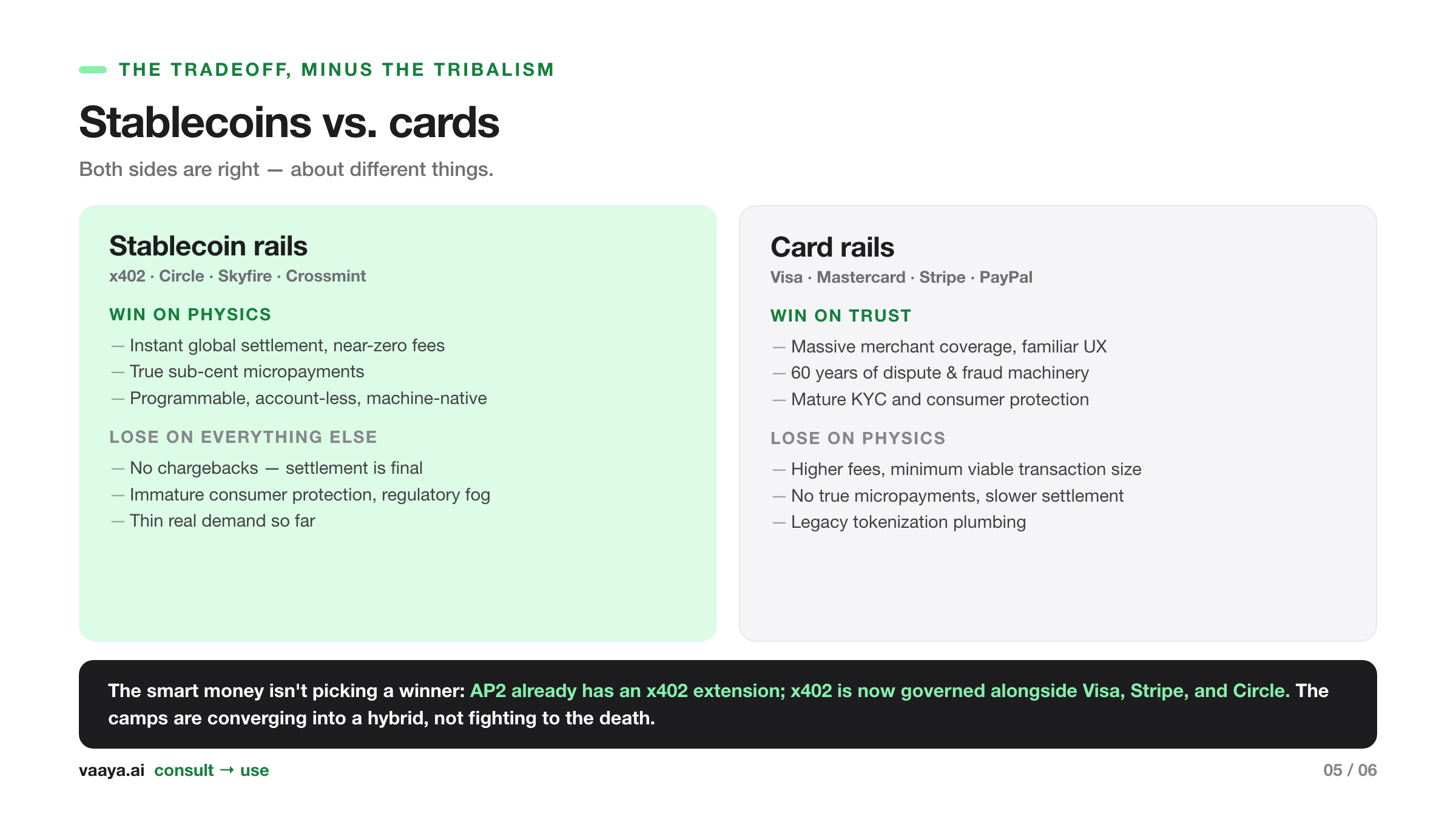
The loudest debate is the least useful one, because both sides are right about different things.
Stablecoin rails (x402, Circle, Crossmint, Skyfire) win on physics: instant settlement, true sub-cent micropayments, programmable, near-zero fees, no accounts or API keys, global by default. They lose on everything that isn't physics: no chargebacks, immature consumer protection, regulatory fog, and — today — thin real demand.
Card rails (Visa, Mastercard, Stripe, PayPal) win on everything that isn't physics: enormous merchant coverage, built-in disputes and fraud, mature KYC, consumer protection, a UX people already trust. They lose on physics: higher fees, minimum viable transaction sizes that kill true micropayments, slower settlement, legacy plumbing.
Which is why the smart money isn't betting on a winner. AP2 already has an x402 extension. x402 is now governed alongside Visa, Stripe, and Circle. The camps are converging into a hybrid, not fighting to the death.
Where this goes — and the tell everyone's missing
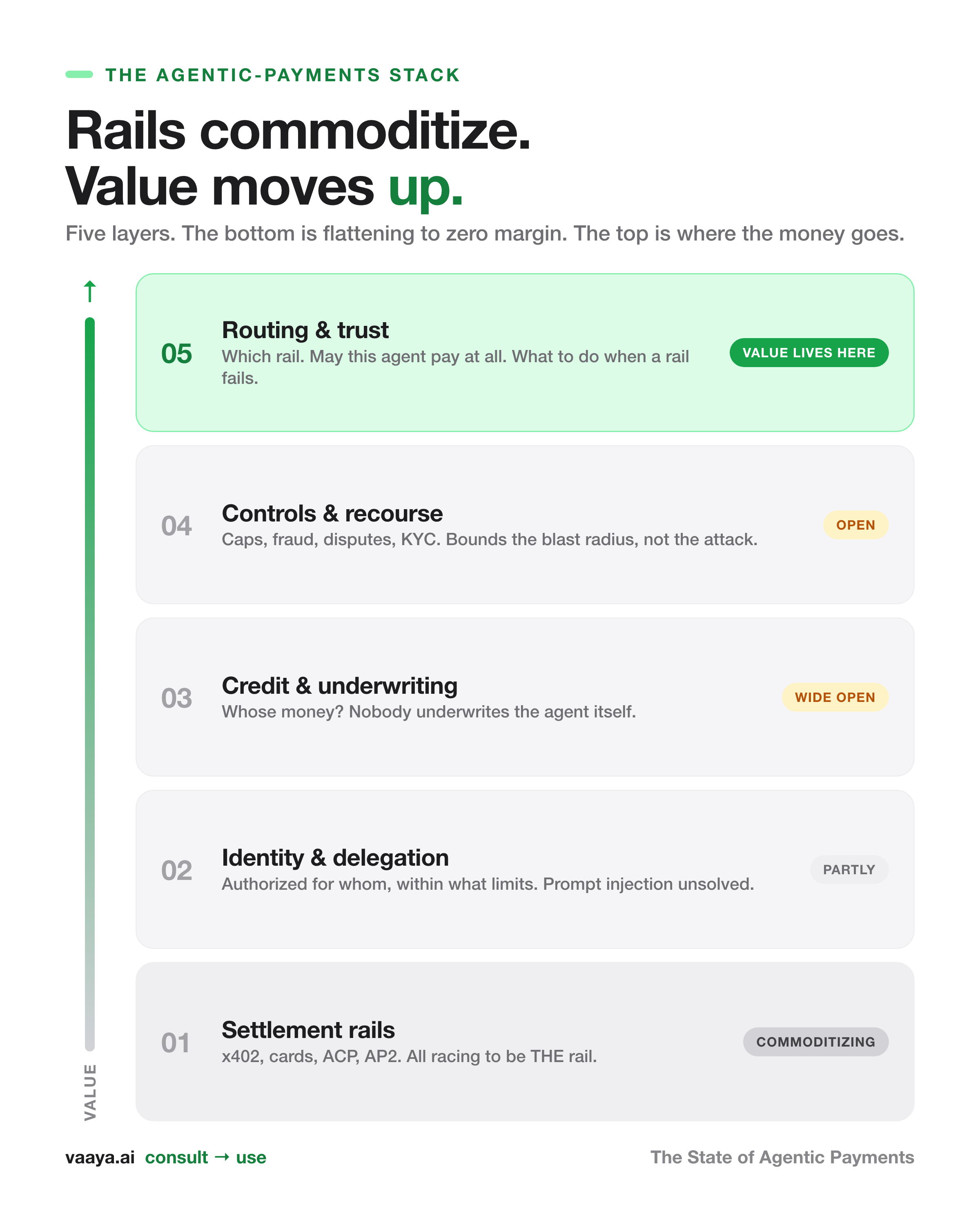
Here's the pattern worth sitting with. It's the oldest one in infrastructure: when a layer becomes a standard, it becomes interchangeable, and interchangeable things can't hold margin. TCP/IP commoditized networking and the value moved up to the cloud. ISPs became dumb pipes and Netflix ate the value riding over them. Stripe abstracted the card networks until developers stopped caring whether Visa or Mastercard settled the charge.
x402, ACP, AP2, agent tokens are all racing to be the rail. But rails converge toward standards, and standards compress to zero margin. If that plays out — and the Linux Foundation consolidation says it's already playing out — no single rail is a durable moat. They all become pipes an agent can settle over.
So where does the value go? Up. To the one layer that has to make a judgment on every single transaction:
- which rail to use — cheapest, fastest, whatever this merchant actually accepts,
- whether this agent is even allowed and able to pay — identity, credit, policy, in one decision,
- what to do when a rail fails — reroute to another, not retry the corpse.
That routing-and-trust layer is where the hard decisions live, and it's the layer that's still scarce. The rails are being commoditized in public, on purpose. The thing that routes across them is not.
Why we're the ones drawing this map
We build Vaaya — one gateway an agent connects to once, that routes across every service and every payment rail underneath, so the agent never has to know or care which one settled. We didn't write this field guide to sell you a rail. We wrote it because we sit above all of them, and the view from up here is clearer than the noise below.
The map is still being drawn. The gateway is live today: one connection, the whole economy on the other side.
Sources: OpenAI & Modern Retail (Instant Checkout); Artemis & CoinDesk (x402 volume); Mastercard (Agent Pay).